Level 1 Reading charts · Part 5/7
Volume: The Second Opinion on Price
The price tells you where the market went. Volume tells you how many participants were involved. Together they say considerably more than the price alone – as long as you know what the measured volume actually covers.
Volume at breakouts
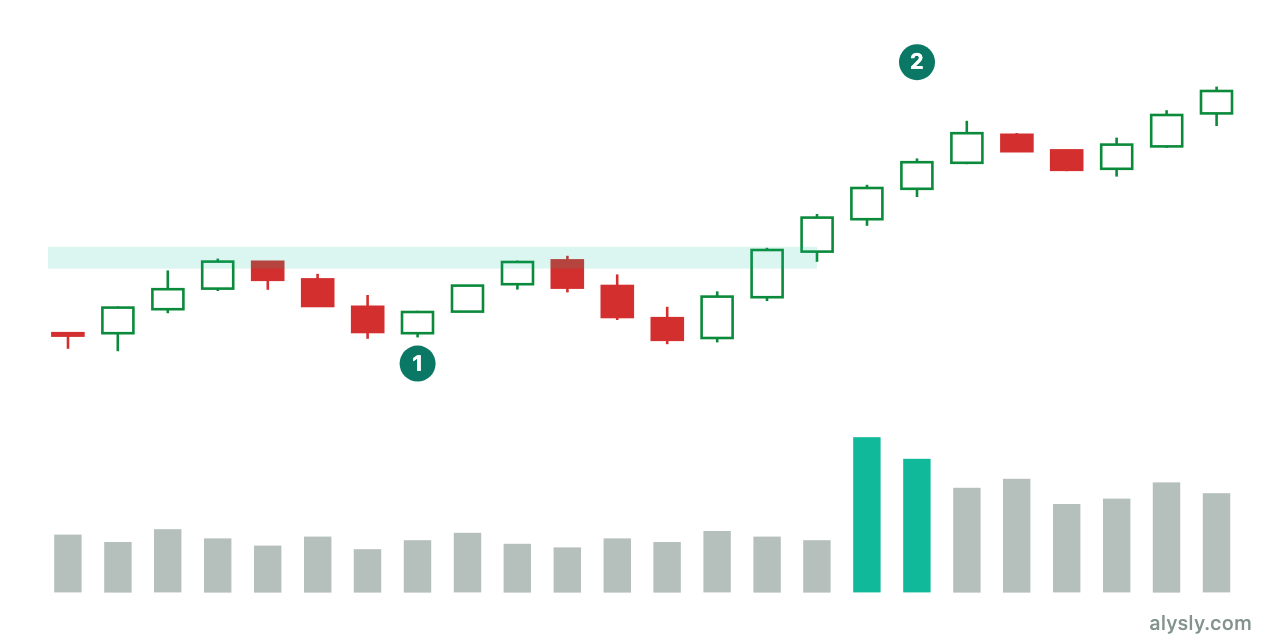
The most reliable use is confirming a breakout. If the price leaves a range on clearly raised volume, many participants are carrying the move. If the same happens on average or low volume, the move is thin. It may still run, but it has less support.
The reference point matters. “High” means high compared with the last twenty periods of the same instrument. Absolute volume figures cannot be compared across instruments.
Typical patterns
- Rising prices, rising volume: many participants carry the move.
- Rising prices, falling volume: the advance is losing participation. That is not a sell signal, but it shows that the move is getting narrower.
- A volume spike after a long trend: often exhaustion or capitulation, the point where the last participants give up. You can identify it reliably only afterwards.
- A volume spike together with a long wick: the market tested a price area with heavy participation and rejected it. That is the most informative combination in this chapter.
Where volume does not work
Volume only means something where it is recorded centrally, and that is far from universal:
- Foreign exchange. There is no central exchange. What platforms display as volume is their own volume or a tick count – a slice of unknown size, not the volume of the market.
- Fragmented stock markets. Part of the flow runs through alternative venues, so the volume of a single exchange does not show the whole market.
- Crypto. Exchange volume is real, but every venue counts separately and the quality of the reporting varies enormously.
Where volume is incomplete, one substitute remains: the range of the candle. Large ranges come with high activity, small ranges with low activity. This is a rougher measure, but it is available everywhere – and it is exactly what average true range is built on.
Volume and ETFs
One special case has practical consequences. For an ETF, low trading volume is not a warning sign about the fund. Its price comes from the value of the securities it holds, and authorized participants can create new shares at any time. Low volume mainly means a wider spread between bid and ask – a cost question when you buy, not a verdict on the product.
Next
That covers the building blocks of chart reading. The next article deals with the arithmetic that comes before any pattern: how much a single position is allowed to cost you.