Trading cards as an investment: real auction prices
Trading cards graded PSA 10 as an investment: real sale prices, returns and a comparison against the S&P 500, MSCI World, Bitcoin and gold.
Why trading cards appear next to ETFs
An investment does not become measurable because someone calls it valuable. It becomes measurable when there are prices that someone actually paid. That is where collectibles usually fail: the “market value” of a card is mostly an asking price. It shows what sellers want, not what buyers pay.
Every series on these pages comes from completed auctions only: a date, a hammer price, a record. These single sales are combined into a median for each period. The result looks like a price history, so it runs through the same math as any index: the same return formula, the same charts, the same correlation.
That makes something possible here that is rare elsewhere: comparing one card directly with the S&P 500 , MSCI World , Bitcoin and gold , over the same period and with the same method. Whether the comparison looks good or bad for a card is not decided by the selection, but by the data. Both happen, and both stay visible.
Why only the Wizards era
The catalog covers the English and Japanese sets from the years when Wizards of the Coast published Pokémon cards outside Japan (1999–2003). That limit is deliberate, and the reason lies in the data: for these sets, the number of copies that exist is fixed. No new ones will be printed.
What counts is not the print run itself, but how many cards can still reach a PSA 10 grade. Production back then had none of the quality control of today’s sets: centering, cut edges and surfaces vary a lot, and much of the print run was played with rather than stored away. So the pool of cards that can still reach top condition grows only slowly. Every new PSA 10 has to come from a stock that has not grown in more than twenty years.
Modern sets work differently. They are printed in large numbers, reach the top grade far more often thanks to better production, and a large share goes straight from the booster pack to grading. The number of graded copies of a popular modern card can therefore keep rising for years while demand is already there.
This is not a judgment on individual modern cards. Some of them have very small populations, and the same argument applies to them. It is a selection rule for a database: a series is more reliable when the supply side no longer changes much.
Why PSA 10 and nothing else
Every series here covers cards graded PSA 10 only. Without that rule the numbers would be useless: a PSA 9 and a PSA 10 of the same card often differ by several times in price, and a median that mixes both would describe no real object. A single grade is what makes two sales comparable in the first place.
What these numbers cannot tell you
Trading cards change hands rarely. Many cards have only a handful of sales per year, and one unusual lot moves the median noticeably. That is why every series states how many sales it is based on and which period it covers. Both are part of the result.
Some costs never show up in a price curve. They include buyer’s premium and seller’s commission, shipping, insurance, storage, grading fees and the waiting time that comes with them. On top of that come the risk of fakes and the chance that no buyer appears for months. A stock can be sold in seconds; a card cannot. A card also pays no income while it is held: no interest, no dividends. The entire return sits in the price.
These series show what people paid in the past. They say nothing about future prices.
PSA 10 Pokémon Trading cards vs. the markets
Real auction prices of PSA 10 cards against the S&P 500, MSCI World, Bitcoin and gold. All lines indexed to 100 as of 2024-07-11, logarithmic scale.
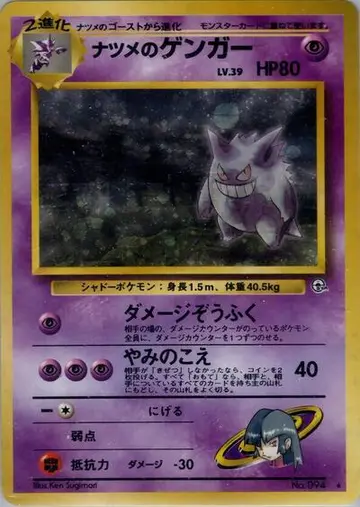 PSA 10 Pokémon Sabrina's Gengar #94Japanese Gym 2 (1999)
History and sales →
PSA 10 Pokémon Sabrina's Gengar #94Japanese Gym 2 (1999)
History and sales →Sabrina's Gengar #94 +1783 % S&P 500 +25 % MSCI World +38 % Bitcoin +37 % Gold +68 %
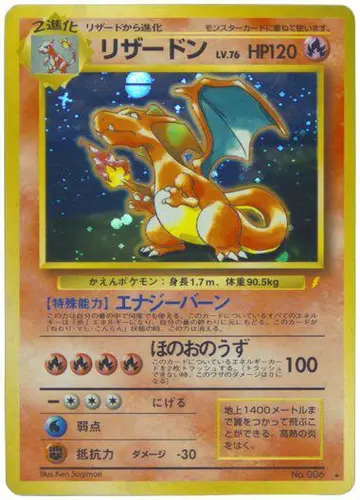 PSA 10 Pokémon Charizard #6Japanese CD Promo (1999)
History and sales →
PSA 10 Pokémon Charizard #6Japanese CD Promo (1999)
History and sales →Charizard #6 +500 % S&P 500 +25 % MSCI World +38 % Bitcoin +37 % Gold +68 %
 PSA 10 Pokémon Dark Charizard #4Team Rocket 1st Edition (2000)
History and sales →
PSA 10 Pokémon Dark Charizard #4Team Rocket 1st Edition (2000)
History and sales →Dark Charizard #4 +85 % S&P 500 +25 % MSCI World +38 % Bitcoin +37 % Gold +68 %
 PSA 10 Pokémon Blaine's Charizard #2Gym Challenge 1st Edition (2000)
History and sales →
PSA 10 Pokémon Blaine's Charizard #2Gym Challenge 1st Edition (2000)
History and sales →Blaine's Charizard #2 +69 % S&P 500 +25 % MSCI World +38 % Bitcoin +37 % Gold +68 %
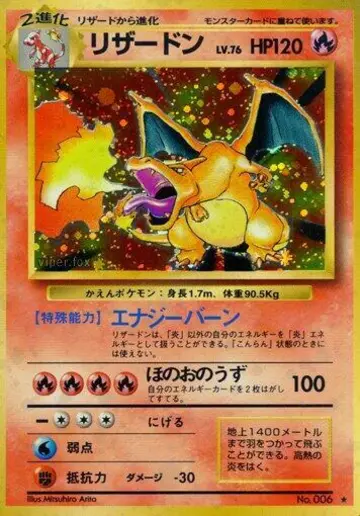 PSA 10 Pokémon Charizard #6Japanese Base Set (1996)
History and sales →
PSA 10 Pokémon Charizard #6Japanese Base Set (1996)
History and sales →Charizard #6 +14 % S&P 500 +25 % MSCI World +38 % Bitcoin +37 % Gold +68 %
Period 2024-07-11 to 2026-08-31. Positions are picked by the number of recorded sales, not by return. Prices are hammer prices including the buyer's premium; seller's commission, taxes and holding costs are not deducted. All cards in detail