Level 2 Patterns & indicators · Part 2/9
Continuation Patterns and the Doji Family
Not every candlestick pattern announces a turn. A large share of them describe either indecision or the continuation of a move that is already running.
The doji family
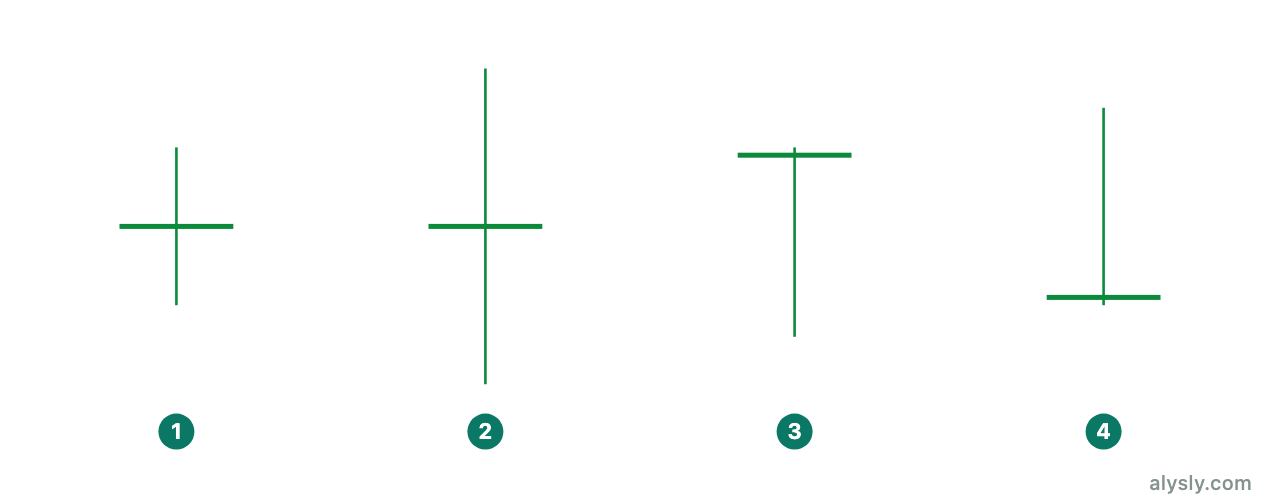
A doji has almost no body: open and close are at the same level. The candle says exactly one thing: nothing was decided during the period. The variants differ only in their wicks:
- Standard doji: wicks on both sides, balanced.
- Long-legged doji: very long wicks on both sides. A lot of movement, no result; common at turning points and around news.
- Dragonfly doji: long lower wick, no upper one. A relative of the hammer.
- Gravestone doji: long upper wick, no lower one. A relative of the shooting star.
The doji is the best proof that a candlestick pattern is empty without context. After a long rally it is a pause; in a sideways range it is the normal state. The candle itself is identical.
Marubozu and spinning top
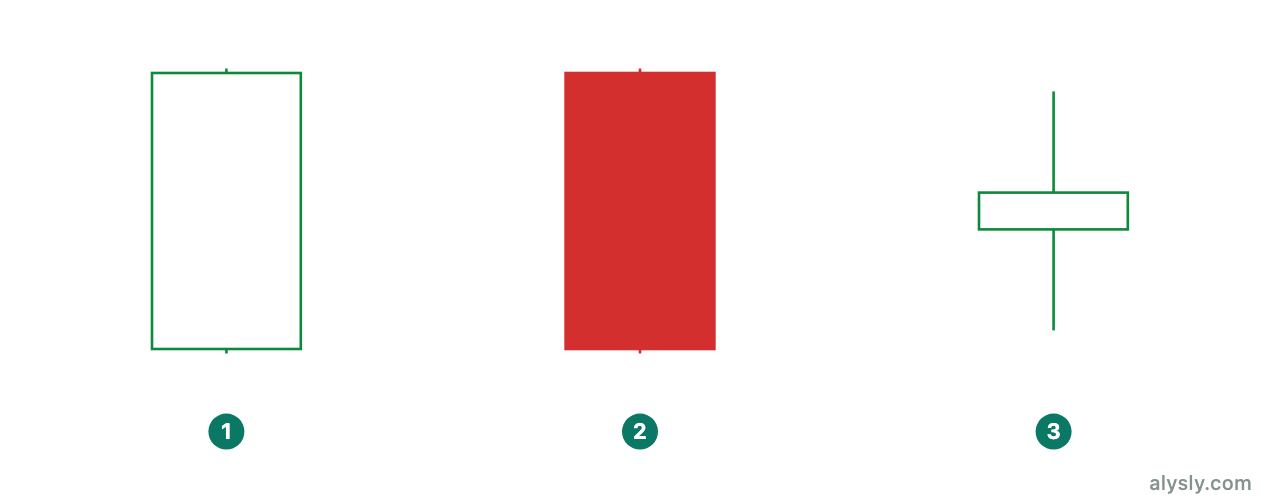
The marubozu has no wicks, or almost none: open and close sit at the ends of the range. One direction for the whole period: the strongest form of agreement a single candle can show.
The spinning top is the opposite: a small body with wicks on both sides. It says nothing about direction, but something about participation: the market moves without deciding anything.
Sequences
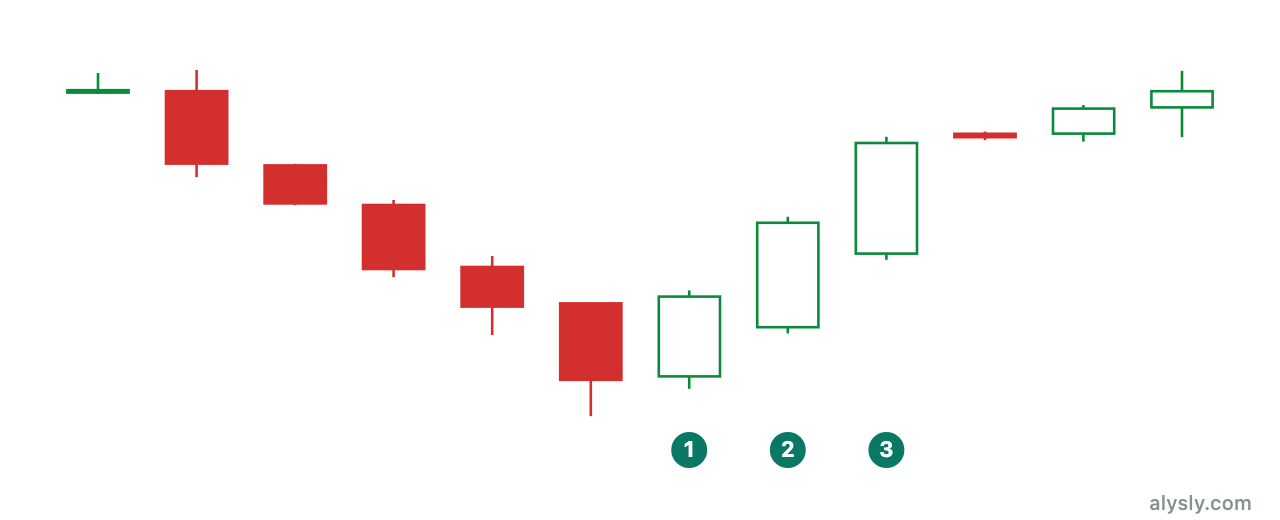
Three white soldiers: three strong up candles in a row, each one opening inside the previous body and closing above its high. The pattern describes a move that rises step by step and is broadly carried.
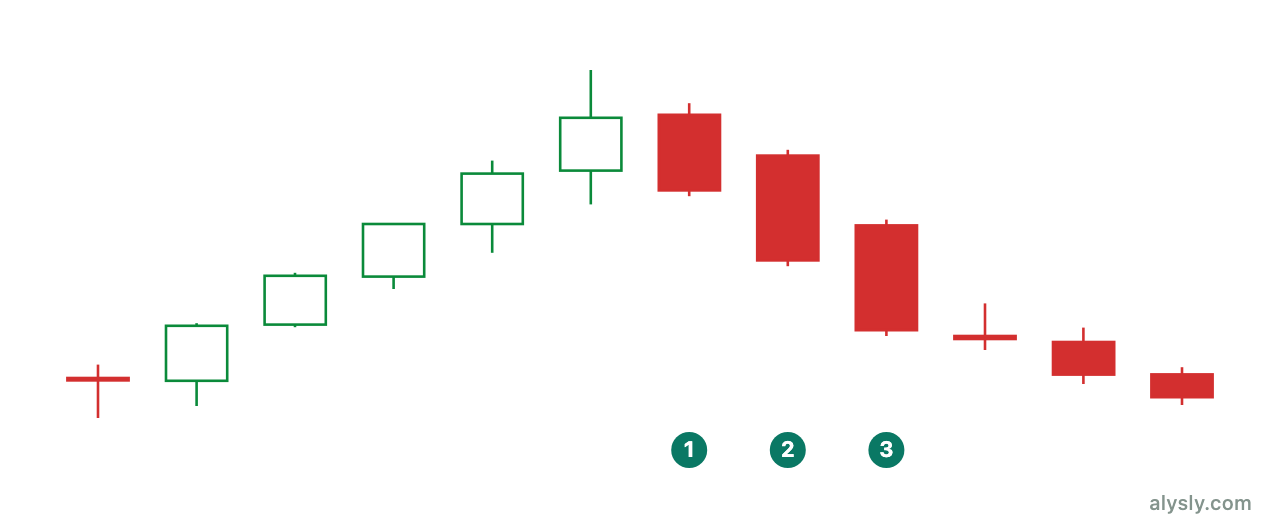
Three black crows is the counterpart. Both sequences have the same built-in drawback: by the time you can recognize them, a good part of the move has already happened. They are descriptions, not entry signals.
Rising three methods
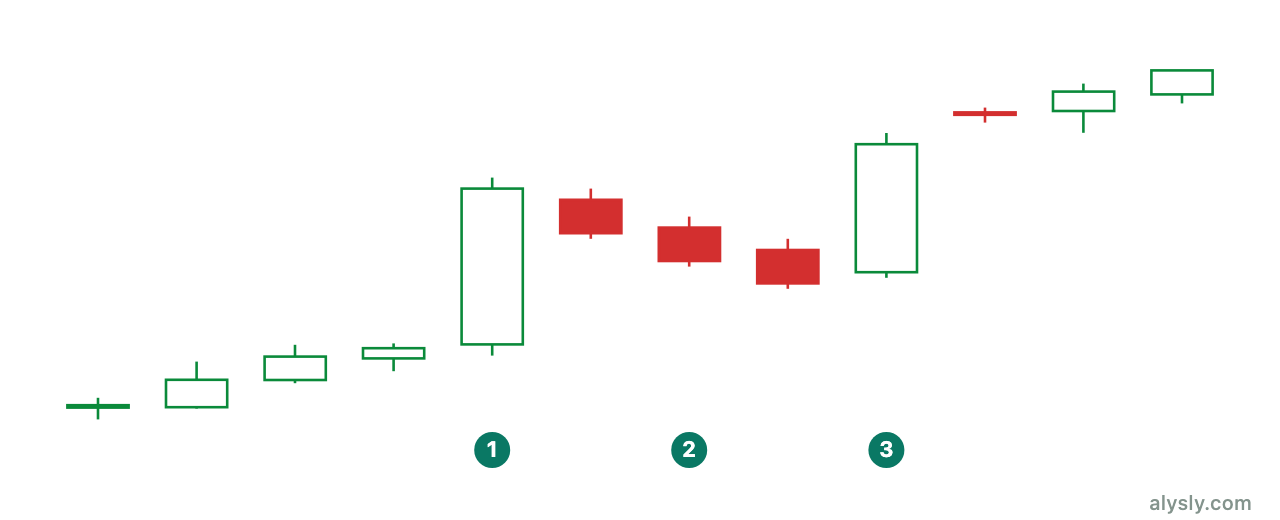
A real continuation pattern: a large candle sets the range, several small counter-candles stay inside it, and then another large candle in the original direction breaks out of it.
The decisive condition is that the pullback does not leave the range of the first candle. It costs time but no ground, and that is exactly what separates a breather from a reversal. The same principle on a larger scale is what charting calls a flag.
Perspective
Continuation patterns are described less often than reversals, even though they happen more frequently. The reason is psychological, not statistical: a turn is the better story. For a portfolio, the boring case is usually the more valuable one, because it answers whether you can keep a position you already hold.
Next
From single candles to formations that run for weeks: reversal chart patterns.