Level 0 ETF basics · Part 4/14
ETF fees: TER and hidden costs
ETFs are cheap, but not free. Four types of cost determine how much of the index return reaches the investor.
1. TER: the ongoing fund fee
The Total Expense Ratio states the ETF’s yearly management cost in percent. It is taken continuously from the fund’s assets; there is no separate bill.
Typical values:
- Broad index ETFs (S&P 500 , MSCI World ): 0.05–0.25 %
- Specialty/thematic ETFs: 0.3–0.7 %
Every ETF page shows the TER in the key facts.
2. Tracking difference: the actual deviation
The TER is the stated fee. The tracking difference measures how far the fund’s actual return deviates from the index, including the fund’s trading costs and income such as securities lending. It can be smaller or larger than the TER and is the more precise cost measure, though less often published.
3. Trading costs
- Order fee: what the broker charges per trade; 0–1 € at many neobrokers, savings plans often free.
- Spread: the gap between buy and sell price. Small for large, liquid ETFs, wider outside main trading hours.
How costs add up over decades
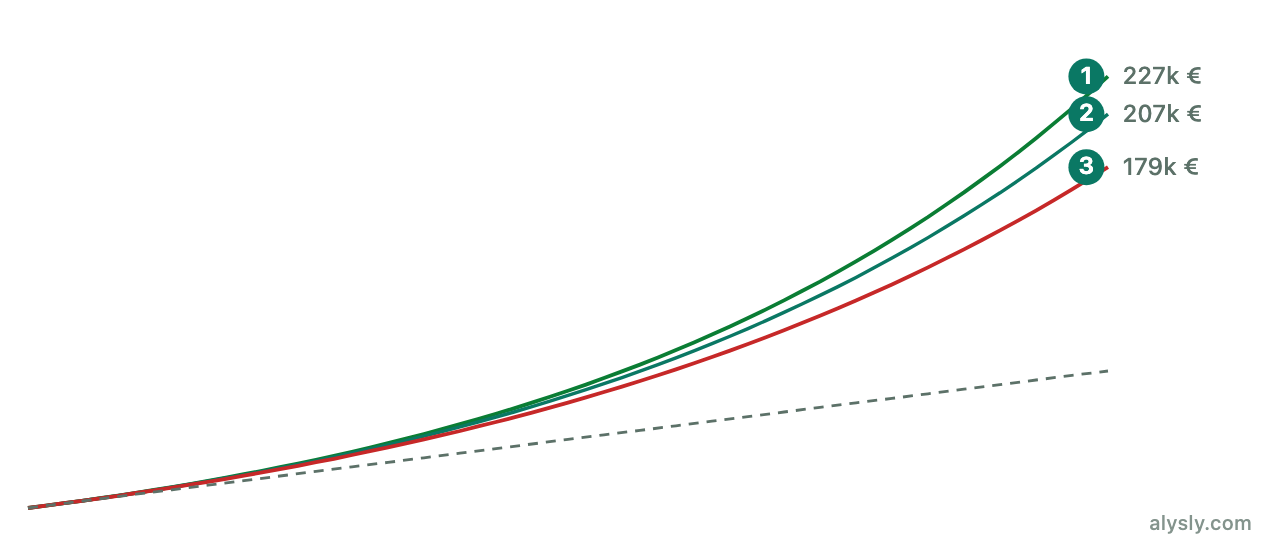
Costs reduce not only one year’s return but also the compounding on every following year. Example: 200 € a month over 30 years at a 7 % gross annual return (paid in: 72,000 €):
- 0.20 % TER: about 226,700 €
- 0.70 % TER: about 206,800 €
In this example the half percentage point costs almost 20,000 €. The return is an assumption, not a forecast. Your own figures can be run in the savings plan calculator .
Bottom line
Costs are one of the few properties of an investment that can be known reliably in advance. Between funds on the same index, a difference in TER measurably affects the final value over decades.
This article is for information only and is not investment advice.